You’re used to performing at a high level, in your career, as a parent, in the gym, and lately something feels off. Maybe it’s energy that disappears by mid-afternoon. Maybe it’s a mental fog that wasn’t there two years ago, or a body composition shift no amount of effort in the gym seems to fix. Maybe it’s hot flashes and disrupted sleep that showed up seemingly overnight. All of these can trace back to the same shifting hormonal landscape, and none of them have to wait for a menopause diagnosis to be worth addressing.
Hormonal changes can start up to 10 years before menopause, and too often what you get back is a shrug: normal labs, vague reassurance, or a suggestion to manage your stress better. That’s not an answer. We believe you deserve one, built around your specific hormones, not a generic checklist of menopause symptoms.
At Ethos Integrative Medicine in Scottsdale, we treat the full range of hormonal shifts affecting high-performing women, from the first signs of perimenopause through post-menopausal health, addressing energy, cognitive sharpness, body composition, mood, and libido as one connected picture rather than isolated complaints.
Menopause is a single point in time, twelve consecutive months without a period. Perimenopause is the years leading up to it, and it’s where most of the symptoms you’re actually feeling begin. Estrogen and progesterone don’t decline in a straight line during this window, they fluctuate, sometimes sharply, which is exactly why symptoms can feel inconsistent and confusing rather than steady.
| Why does this distinction matter for treatment?
Perimenopause often involves fluctuating, unpredictable hormone levels that benefit from a strategy built around balancing that variability. Post-menopausal hormone levels are consistently low, which calls for a more stable, sustained approach. |
This is also why so many women in their early-to-mid 40s get told their labs are normal and their symptoms are stress. Perimenopausal hormone fluctuation doesn’t always show up clearly on a single lab draw, which is exactly the gap a broader hormonal and metabolic workup is built to catch.
Signs we commonly see: unpredictable mood shifts, sleep disruption, and cognitive fog that fluctuate rather than follow a steady pattern.
Signs we commonly see: hot flashes, night sweats, and a more sustained shift in energy, body composition, and libido.
Signs we commonly see: unexplained weight changes, persistent fatigue despite adequate sleep, and stress resilience that feels lower than it used to.
Signs we commonly see: stubborn weight gain, especially around the midsection, that doesn’t respond to the diet and exercise approach that used to work.
Signs we commonly see: reduced desire, discomfort, or a general sense of disconnection from a part of your health you used to take for granted.
Signs we commonly see: irritability or anxiety that feels disproportionate, difficulty staying asleep, and trouble concentrating or finding words as quickly as you used to.
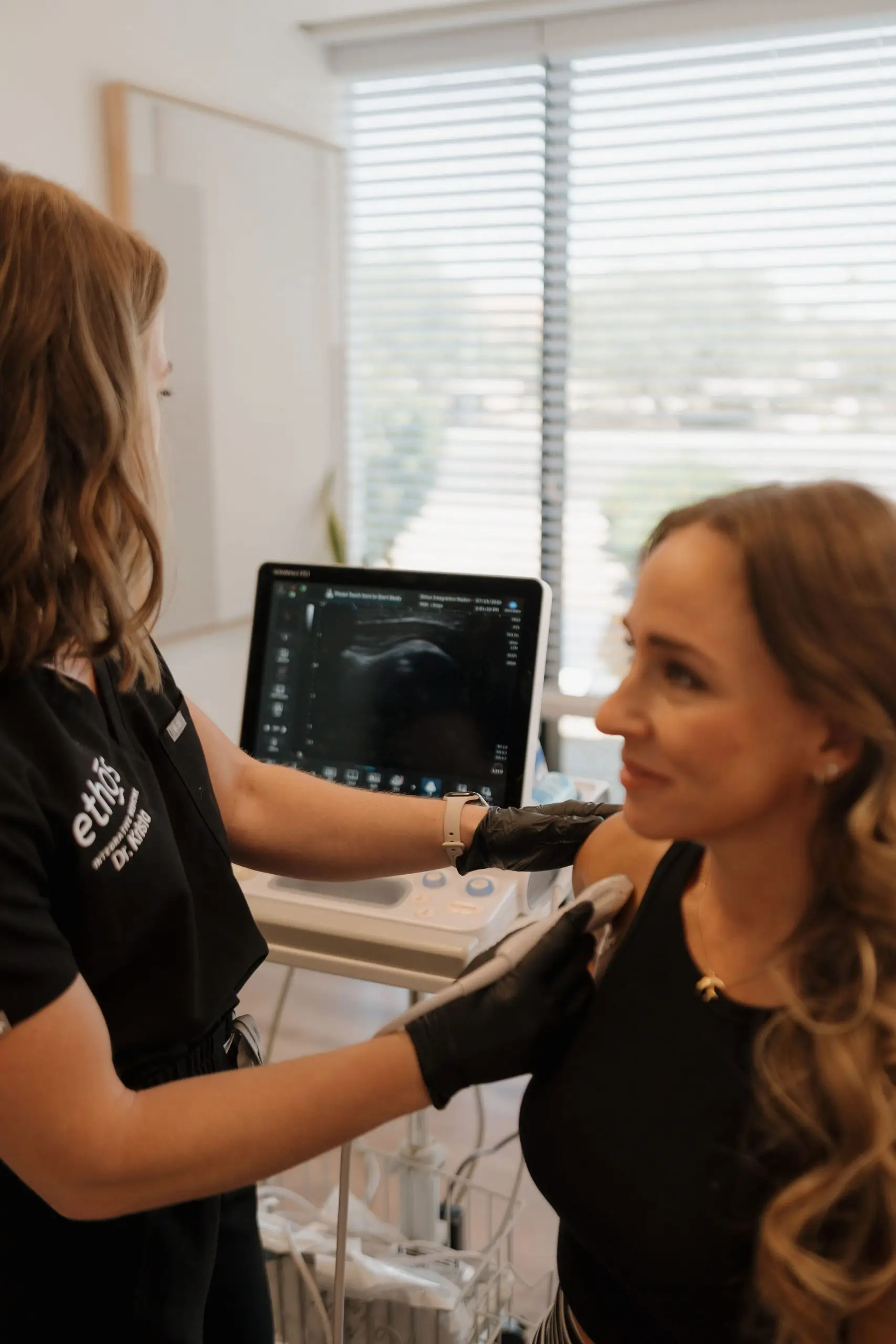
Most standard HRT prescribing starts and ends with menopause symptoms. You describe hot flashes or sleep disruption, get a prescription, and see your provider again in a year. That can quiet the most obvious symptoms. It won’t tell you whether thyroid function, cortisol, or metabolic health are compounding what you’re feeling, and it won’t catch the perimenopausal fluctuation that a single symptom-based visit is structurally built to miss.
It also won’t adjust as you change. Hormone levels during perimenopause shift over months, not years, and a protocol set once at a brief annual visit has no way to track that movement. Without structured monitoring, a prescription that made sense at your last visit can quietly stop matching what your body is actually doing.
| Factor | Standard OB-GYN HRT | Ethos Deep Dive |
|---|---|---|
| Diagnostics | Symptom-based, limited labs | Health Intelligence Deep Dive (56-Point Health Inspection) |
| Physician Time | Brief visits | Physician-led throughout |
| Scope | Menopause symptoms only | Full hormone, thyroid, metabolic picture |
| Ongoing Monitoring | Rarely | Ethos Performance Scorecard |
Wondering whether your symptoms are perimenopause, something else, or both? Book a Discovery Call to start your Health Intelligence Deep Dive.
| What happens during the Health Intelligence Deep Dive process? (NEW)
Your Health Intelligence Deep Dive starts with a Performance Questionnaire to identify your goals and blind spots, followed by a 56-Point Health Inspection covering hormones, thyroid, adrenal, and metabolic function. From there, you get an easy-to-understand optimization plan and an ongoing Performance Scorecard to track your results over time. |


Whether you’re noticing the first signs of perimenopause or you’re well into menopause, you shouldn’t have to wait for things to get worse before someone takes it seriously. We build your plan around where you are right now.

You deserve more than “that’s just menopause” as an explanation. We skip the vague reassurances and give you a clear picture of what’s actually happening hormonally, and a specific plan built around it.

From energy and focus to body composition and mood, our approach is built to support the full range of what you’re managing, not just the symptoms that happen to be the most visible.

Ethos Integrative Medicine was founded in 2015 and has treated more than 3,000 patients across Scottsdale. Every protocol is led directly by our physicians, not handed off to a rotating staff.
If your partner is also noticing energy, focus, or body composition changes, learn more about our Men’s Hormone Optimization program. Many of our patients bring their partners in once they see their own results.

Co-Founder
Longevity & Medical Aesthetics Expert

Joint Pain Expert
Hormone Specialist

Autoimmune and
Rheumatology Expert
Is hormone therapy safe for women who are still cycling?
Yes, hormone optimization isn’t limited to women who are post-menopausal. Many of our perimenopausal patients are still cycling, and their protocols are built around stabilizing fluctuation rather than replacing hormones that have already dropped off consistently.
What’s the difference between treatment for perimenopause vs. menopause?
We treat these differently for exactly the reason described above, perimenopause and menopause call for different strategies, not the same protocol at different doses. If you’re not sure which one describes what you’re experiencing, that’s exactly what your Health Intelligence Deep Dive is built to sort out.
Will hormone optimization affect my ability to perform at a high level at work?
For most patients, the goal is the opposite of a disruption, it’s getting back the cognitive sharpness, energy, and focus that hormonal shifts have quietly been taking away. Many patients tell us the biggest change is in exactly the areas that affect their professional performance.
What’s the difference between bioidentical and synthetic hormones?
Bioidentical hormones are structurally identical to the hormones your body produces naturally, while synthetic versions are chemically similar but not identical. We evaluate which approach fits your specific labs and goals rather than defaulting to one option for every patient.
How does thyroid health relate to hormone optimization?
Thyroid function influences energy, weight, mood, and temperature regulation, all of which overlap heavily with perimenopause and menopause symptoms. Because of that overlap, thyroid markers are evaluated as part of a full hormonal picture rather than in isolation.
How often will I need follow-up testing?
Follow-up testing is tracked through your Ethos Performance Scorecard on a structured schedule, not left until your next annual visit, so your protocol can adjust as your hormones shift rather than after the fact.
Is hormone optimization covered by insurance?
Ethos is a private-pay practice. That model is what allows your physician to spend time interpreting your results and adjusting your protocol, rather than working within the constraints of insurance-based visit schedules.
What if my symptoms don’t match a textbook menopause description?
That’s more common than not. No two women’s hormonal pictures look identical, and a textbook symptom list is built from population averages, not your specific biology. That’s exactly why we start with a full picture of your hormones and metabolic health, not a checklist of what menopause is supposed to look like.

Book a Discovery Call to start your Health Intelligence Deep Dive.
Ethos Integrative Medicine proudly serves individuals in Scottsdale, Phoenix, Glendale, Mesa, and beyond.