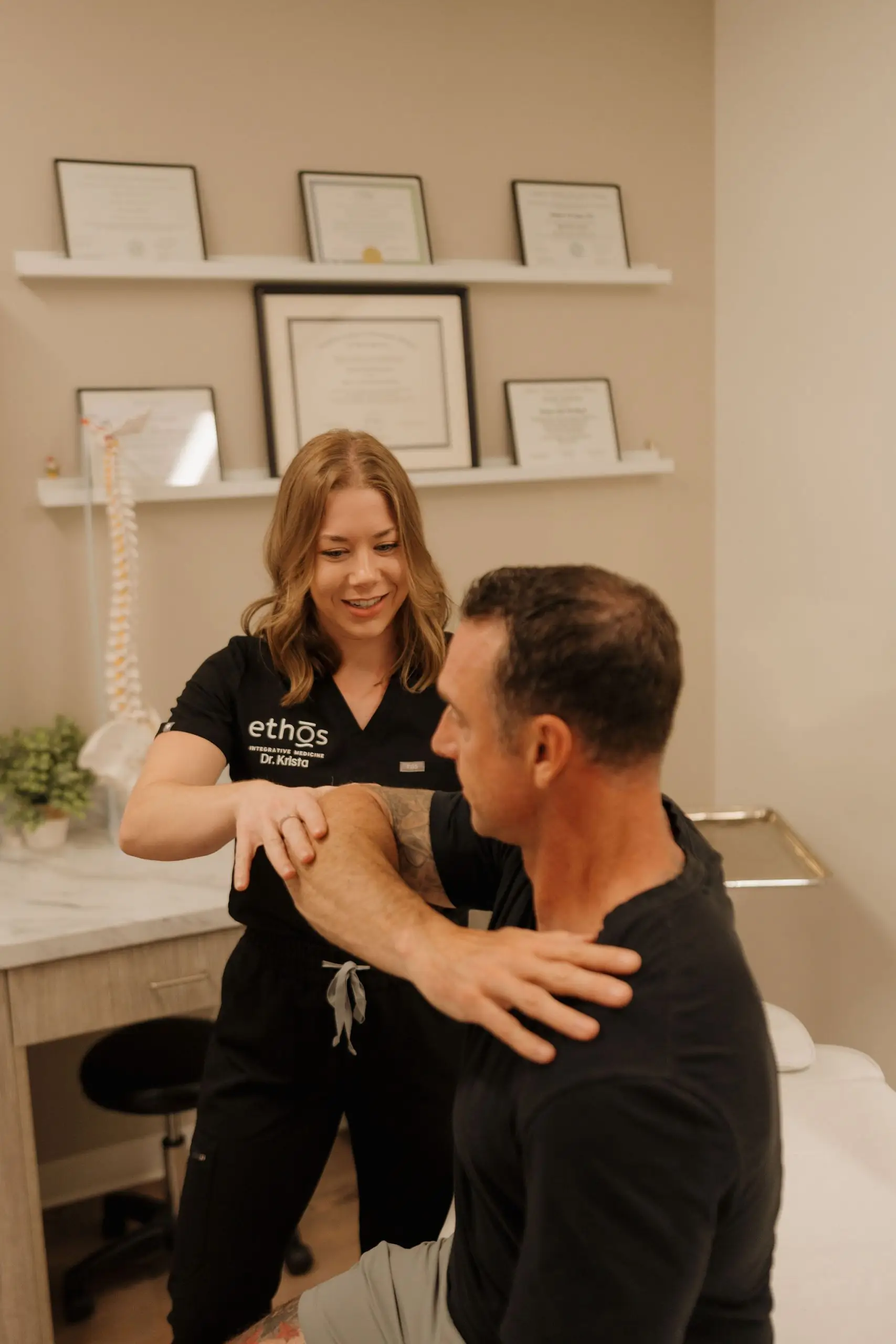
You’ve seen everyone for shoulder pain, and are still left without solutions. Massage, corticosteroid injections, physical therapy, and chiropractic care only offered temporary relief. Surgery is not an option, and you don’t want to rely on pain meds. You’re told that your only option is to stop being active and wait till it gets worse. We believe you deserve relief now.
You don’t have to retire from tennis or quit swimming. Being told your only option is to “stop being active” is not a solution in our book. The truth is, you can get lasting relief now.
At Ethos Integrative Medicine in Scottsdale, we’re experts in addressing shoulder pain caused by tendon, ligament, nerve, and joint injuries. We specialize in precise, regenerative orthopedic treatments, tackling the source of your discomfort and restoring function in your shoulder. Whether pain disrupts daily tasks or your favorite sport, our comprehensive, cutting-edge approach ensures pain relief and improved mobility, so you can confidently get back to doing what you love.
You’ve adjusted your serve, changed your grip, modified your stroke, maybe even taken time off entirely, and the shoulder pain still finds its way back. That’s usually a sign the last round of treatment addressed the symptom, not the mechanical problem underneath it.
Most recurring shoulder pain in active adults comes down to a few overlapping issues:
.
| Why does shoulder pain keep returning after treatment?
Shoulder pain often returns after PT or injections because those treatments manage symptoms, not the underlying cause. Usually that cause is some combination of rotator cuff strength loss, scapular compensation, and repetitive overhead load. Lasting relief means correcting that root mechanical cause, not just calming the joint temporarily.
|
Signs we commonly see: pain with overhead movement, weakness lifting or reaching, and night pain disrupting sleep.
Signs we commonly see: pain with overhead reaching, and a catching or pinching sensation during specific movements.
Signs we commonly see: progressive stiffness and loss of range of motion, along with pain even at rest.
Signs we commonly see: a chronic ache that worsens with activity, and stiffness that’s most noticeable in the morning.
Each of these has real value, but none of them was designed to solve chronic shoulder pain on its own.
Rest lets inflammation settle, but it doesn’t rebuild the strength or stability your shoulder lost while you were favoring it.
Physical therapy can restore some mechanics, but if the tendon or capsule itself is still damaged, the same pattern tends to resurface once you’re back to full training or play.
Cortisone injections quiet pain fast, which is exactly why they feel like progress, but they’re calming inflammation, not repairing tissue.
That’s why so many patients describe the same frustrating loop: relief for a few weeks, then right back to where they started.
Your shoulder pain has a specific cause, and we don’t guess at it. Once your Precision Shoulder Scan and Pain Map show us exactly what’s driving your pain, we build your plan around that, not a standard protocol handed out to every patient who walks through the door.
Depending on what we find, your plan may include Prolotherapy, PRP Therapy or both. These are regenerative treatments we use here in Scottsdale, designed to get your own tissue rebuilding, not just to quiet the pain signal for a few weeks.
And we don’t stop at the injection. A physician stays involved through every stage of your treatment, adjusting your plan as you respond, because real recovery takes oversight, not a one-and-done appointment. That standard of care defines our entire regenerative medicine program.
Not every shoulder condition calls for the same level of intervention. Here’s how the two paths generally compare:
| Factor | Non-Surgical Regenerative | Surgery |
|---|---|---|
| Invasiveness | Low (injection-based) | High |
| Typical Recovery | Weeks | Months |
| Return to Sport | Faster, progressive | Extended rehab required |
| Best For | Most tendon/joint degeneration cases | Full-thickness tears, severe structural damage |
Is non-surgical shoulder treatment as effective as surgery?
Non-surgical regenerative treatment is lower-invasiveness, with recovery typically measured in weeks rather than months, and is appropriate for most tendon and joint degeneration. Surgery remains the right call for full-thickness tears or severe structural damage, not the default first option.
Not sure whether your shoulder needs surgery or a non-surgical approach? Book a Discovery Call to find out what your diagnostics actually show.
Whether it’s tennis, golf, swimming, or pickleball, our goal isn’t just quieting your shoulder pain, it’s getting you back to playing the way you used to, without thinking twice about it.
No more bouncing between providers with no clear diagnosis. We’ll show you exactly what’s driving your shoulder pain and give you a straightforward path to fixing it.
Every plan draws on innovative regenerative treatments matched to your specific shoulder findings, not a generic protocol, so you’re treated as an athlete first, not just another orthopedic patient.
Many of our shoulder patients come from North Scottsdale and Paradise Valley, active adults who aren’t willing to let joint pain take tennis, golf, or swimming off the table.
When you choose Ethos in Scottsdale, you’re not just selecting a physician; you’re gaining access to a dedicated team of specialists collaborating to help you achieve optimal health.
Co-Founder
Longevity & Joint Pain Expert
Joint Pain Expert
Hormone Specialist
Joint Pain Expert
Hormone Specialist
I’ve already tried a cortisone injection and it didn’t last. Why would this be different?
Cortisone is an anti-inflammatory, not a repair mechanism, so it was never going to fix what’s actually torn or degenerated in the tendon. PRP and prolotherapy work on the tissue itself, prompting your body to rebuild the structure that’s failing, which is why the change shows up gradually over months instead of disappearing in a few weeks like a cortisone shot does.
Will this actually get me back to tennis, golf, swimming, or pickleball, or just make daily life more comfortable?
Full return to your sport is the actual goal here, not just a shoulder that stops complaining at rest. We build your plan around the specific motion your sport demands, an overhead serve loads the shoulder very differently than a swim stroke or a golf swing, so progress is measured against getting you back to that motion, not just a pain scale.
How do you decide between PRP and Prolotherapy for my shoulder specifically?
It depends on what’s actually damaged. Tendon degeneration and ligament or capsule instability don’t respond to the same treatment, which is exactly why we don’t pick a modality until your Precision Shoulder Scan and Pain Map show us what we’re dealing with.
I’ve been told I’ll eventually need surgery. Does this just delay the inevitable?
Not for most patients. Surgery is often framed as inevitable when the actual driver, tendon damage, instability, load imbalance, was never directly treated. Address that root cause early enough, and you’re changing the outcome, not just postponing the same one.
How many treatments will this take, and when will I notice a difference?
It varies based on which treatment you need and how much damage has already accumulated, and we’ll give you a realistic timeline once we know that. As a general pattern, these treatments build week over week rather than delivering an immediate fix, which is also why the results tend to actually last.
What’s the difference between a rotator cuff tear and shoulder impingement?
A rotator cuff tear involves actual damage to the tendon fibers, while impingement is a mechanical pinching that happens when the space the tendon moves through narrows, often from swelling, posture, or scapular mechanics. Impingement left untreated can eventually contribute to a tear, which is why an accurate diagnosis matters.
Can frozen shoulder actually be treated without surgery?
Yes, in most cases. Frozen shoulder is driven by capsule stiffness and inflammation rather than structural tearing, which makes it a strong candidate for regenerative and mobility-focused treatment aimed at restoring range of motion, rather than a case where surgery is the default next step.
Is shoulder arthritis a candidate for regenerative treatment, or only younger injuries?
Regenerative treatment isn’t limited to acute or sports-related injuries. Many of our shoulder arthritis patients see meaningful relief in pain and function, particularly when the goal is delaying or avoiding surgery rather than reversing joint changes that have already occurred.
Ready to find out what’s actually driving your shoulder pain? Schedule a Discovery Call and learn if you’re a candidate for regenerative treatment.

The first step to addressing your shoulder pain is determining what is causing it. Our expert guide is designed to do just that! Knowing where you are experiencing pain can help to clarify and provide next steps for getting relief.
Shoulder SOS: The Expert Guide to Decoding Your Pain
Ethos Integrative Medicine proudly serves individuals in Scottsdale, Phoenix, Glendale, Mesa, and beyond.