
For joint, tendon, and ligament pain that rest, therapy, and cortisone never actually solved.
Almost every patient who asks us about prolotherapy has already done the conventional sequence in good faith. Rest. Physical therapy. An anti-inflammatory. Often a cortisone injection that helped for a few weeks before the pain quietly returned. Somewhere along the way, a specialist likely used the word surgery, as though that were simply the next box to check rather than a genuine last resort. We built our regenerative orthopedics program for exactly this patient: someone who has earned the right to ask whether there is an option that actually resolves the problem, rather than one more way to manage it indefinitely.
Prolotherapy is a physician-administered injection treatment that triggers your body’s own repair response inside a weakened ligament or tendon, addressing the structural cause of joint instability rather than the inflammation around it. At Ethos, prolotherapy is delivered as part of a fully coordinated regenerative orthopedics program grounded in real diagnostic evaluation, never handed off as a stand-alone injection.
If you have been told surgery is your only remaining option, it is worth understanding why that is often not the full picture. Prolotherapy has been used in orthopedic medicine for decades, and the clinical evidence behind it continues to grow, yet it remains one of the more consistently underused treatments in conventional practice, largely because it does not fit neatly into a fifteen minute appointment or a standard treatment algorithm.
At Ethos, prolotherapy is never offered as a stand-alone treatment. It sits inside a broader regenerative orthopedics program alongside PRP and bone marrow concentrate, built on the same diagnostic process we use for every patient who comes to us with joint pain, because the right treatment depends entirely on what your specific tissue actually needs, not on which injection happens to be on the schedule that day.
Prolotherapy works by injecting a proliferant solution, most often a concentrated dextrose solution, directly at the site of a weakened ligament or tendon. The injection itself is not the treatment. It is the trigger. That controlled, localized irritation signals your body to recruit fibroblasts and growth factors to the area, initiating the same collagen building repair process your body would use to heal an acute injury, directed with precision at the exact structure that needs it.
Repeated across a series of sessions, this process gradually increases collagen density and tensile strength in the ligament or tendon, which is why results tend to build over weeks rather than appear overnight. For patients with long-standing joint instability or chronic ligament laxity that has plateaued under rest, physical therapy, or cortisone, this incremental, structural rebuilding is often the piece that was missing from every prior attempt.
How does prolotherapy trigger healing? Prolotherapy injects an irritant solution, typically dextrose, into a weakened ligament or tendon. This activates your body’s natural repair cascade, recruiting fibroblasts and growth factors to the site. Repeated across several sessions, the process builds new collagen and increases tensile strength in tissue that had stopped responding to rest, therapy, or anti-inflammatory treatment.
Prolotherapy is not a single-joint treatment. Because it works directly on the ligament and tendon system, it applies across the body, and our physicians determine candidacy individually for each patient rather than assuming one protocol fits everyone.

Knee osteoarthritis and ligament laxity, particularly for patients whose knee feels unstable during activity or has plateaued under conservative care, are common candidates for prolotherapy.

Hip osteoarthritis and labral related pain often involve surrounding ligament structures that prolotherapy can help stabilize, typically as part of a broader plan alongside other regenerative treatments.

Rotator cuff irritation and general shoulder instability are common reasons active patients seek us out, especially when the underlying issue is ligament or tendon laxity rather than a structural tear requiring surgery.

Tennis elbow and golfer’s elbow (lateral and medial epicondylitis) are among the best studied applications of prolotherapy in the literature, and a frequent reason patients come to us after other treatments have plateaued.

Plantar fasciitis and chronic ankle instability both respond well to prolotherapy in the right candidates, particularly patients who intend to stay active and want to avoid the longer recovery that surgery requires.

SI joint and facet joint ligament laxity are frequent, and frequently missed, contributors to chronic neck and lower back pain. Prolotherapy addresses the ligament instability directly rather than only managing the resulting pain.
Every prolotherapy patient begins with a Deep Dive evaluation specific to the joint or region involved, the same diagnostic rigor we bring to every regenerative orthopedic case at Ethos. Rather than treating a body part in isolation, our physicians assess the full picture, including your activity level, prior treatments, and what you are actually trying to get back to, so your plan reflects your goals rather than a standard protocol.
If you complete your Deep Dive evaluation and do not leave with real clarity about your options, our Leave You Better Promise means you are entitled to a full refund. We would rather absorb that cost than send a patient away with vague answers.
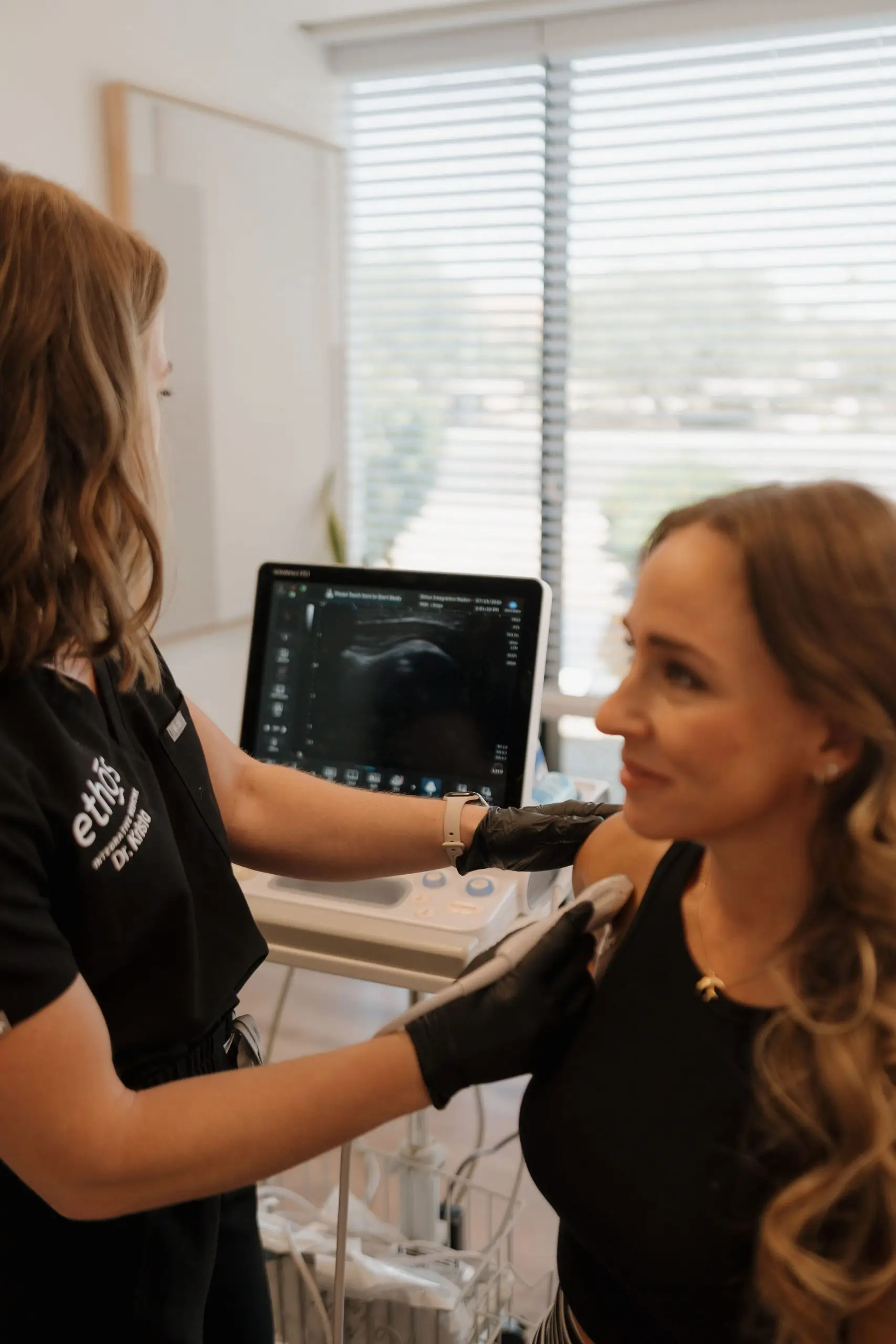
The injection itself is performed by a physician, using ultrasound-guided precision where appropriate to place the solution exactly at the site of ligament or tendon weakness. Most appointments are brief, and most patients are comfortable enough to drive themselves home the same day.
Most patients complete a series of three to six sessions, spaced several weeks apart, giving the repair process time to build. Mild soreness at the injection site for a day or two is common, and it is actually a sign the intended healing response has been triggered, not something to be concerned about. Your physician maps out a specific recovery and activity timeline for each phase, so you always know what to expect and when.
If you have researched regenerative orthopedics at all, you have almost certainly already compared these four options online. Here is the honest version, without the marketing gloss.
| Prolotherapy | PRP | Cortisone | Surgery | |
| Mechanism | Stimulates repair in ligaments and tendons | Concentrated platelets accelerate healing | Reduces inflammation for a period of time | Structural repair or replacement |
| Invasiveness | Low (injection) | Low (injection) | Low (injection) | High |
| Typical sessions | 3 to 6 | 1 to 3 | As needed | One time, plus rehab |
| Addresses root cause | Yes | Yes | No. Masks symptoms | Yes |
A prolotherapy injection is, on its own, a fairly simple procedure. What actually determines the outcome is everything built around it, and that is where the real difference lives.
A 2024 head-to-head comparison found no significant difference in patient-reported outcomes at 12 months between PRP, BMC, and adipose-derived therapies, confirming that individualized patient selection drives results more than any single modality. The right treatment for your injury is determined by what the clinical picture calls for, not by what we happen to offer most frequently.

Is prolotherapy painful?
It is a fair question, and we would rather answer it directly than downplay it. Most patients describe the injection itself as a brief pressure or pinch, comparable to other joint injections. Some soreness at the injection site for a day or two afterward is common, and it is actually part of the intended response, not a sign that something went wrong.
How many sessions will I need?
Most patients complete three to six sessions, spaced several weeks apart. The honest answer is that it depends on the joint, how long the instability has been present, and how your tissue responds along the way, which is exactly why we map this out individually during your Deep Dive evaluation rather than quoting a number before we have examined you.
Does insurance cover this treatment?
No. Ethos is a private-pay practice, and that is intentional. It means your physician’s recommendations are shaped by your biology and your goals, not by what a billing code will approve.
What is the difference between prolotherapy and PRP?
Prolotherapy uses a dextrose-based solution to trigger your body’s own repair response in a weakened ligament or tendon. PRP concentrates platelets from your own blood to accelerate healing at the injury site. Neither is universally better. The right choice depends on the specific tissue involved, which is precisely what your Deep Dive evaluation is designed to determine.
Which conditions respond best to prolotherapy?
Ligament laxity and chronic tendon injuries generally respond well, including knee and hip instability, tennis and golfer’s elbow, plantar fasciitis, and SI joint or facet joint related back pain. That said, generally is not the same as always, which is why a physician evaluation, not a keyword search, is the only reliable way to know whether it fits your specific case.
How soon can I get back to normal activity?
Many patients resume light activity within a day or two. Beyond that, we will not give you a generic number, because a return-to-golf timeline and a return-to-competitive-tennis timeline are not the same thing. Your physician sets a specific timeline based on your joint, your goals, and how your body actually responds.
Is there research behind prolotherapy?
Yes, and it has been accumulating for decades, particularly for knee osteoarthritis, lateral epicondylitis, and ligament-related chronic low back pain. We would rather walk you through the research relevant to your specific condition during a consultation than summarize it in a paragraph meant to apply to everyone.
Who is not a good candidate for prolotherapy?
Patients with an active infection at the injection site, certain bleeding disorders, or joint damage that is primarily structural rather than ligament or tendon related are typically not good candidates. If that describes your situation, we will tell you directly and recommend the option that actually fits, rather than sell you a treatment that will not work.
If you have already tried the conventional path and want a physician’s honest opinion on where prolotherapy actually fits, the next step is a Discovery Call. It is a real conversation with a physician, not a sales appointment, and it is where we determine whether prolotherapy, another regenerative treatment, or something else entirely is the right path for your specific joint.
Ethos Integrative Medicine proudly serves individuals in Scottsdale, Phoenix, Glendale, Mesa, and beyond.