
Fat tissue, delivered with its biology intact
Microfragmented adipose tissue (MFAT) is a regenerative injection made from a small amount of your own fat, processed into tiny tissue clusters and injected into a damaged joint under image guidance, all in a single visit. At Ethos Integrative Medicine in Scottsdale, we recommend it when your imaging and exam show a degenerating joint that’s a good match for what fat tissue can do.
Hardly anyone walks in asking for MFAT by name. Most people have heard of PRP. Some have read about stem cells. Almost nobody expects to hear that their own fat could help a worn-out joint, and the first reaction is usually a raised eyebrow. It makes more sense once you know what fat really is: living tissue, threaded with tiny blood vessels and home to the same family of regenerative cells that makes bone marrow valuable, often in greater numbers.
MFAT earns its own place in our regenerative medicine program. When we recommend it, it’s because your diagnosis points there, and never as a consolation prize for someone who can’t have bone marrow concentrate.
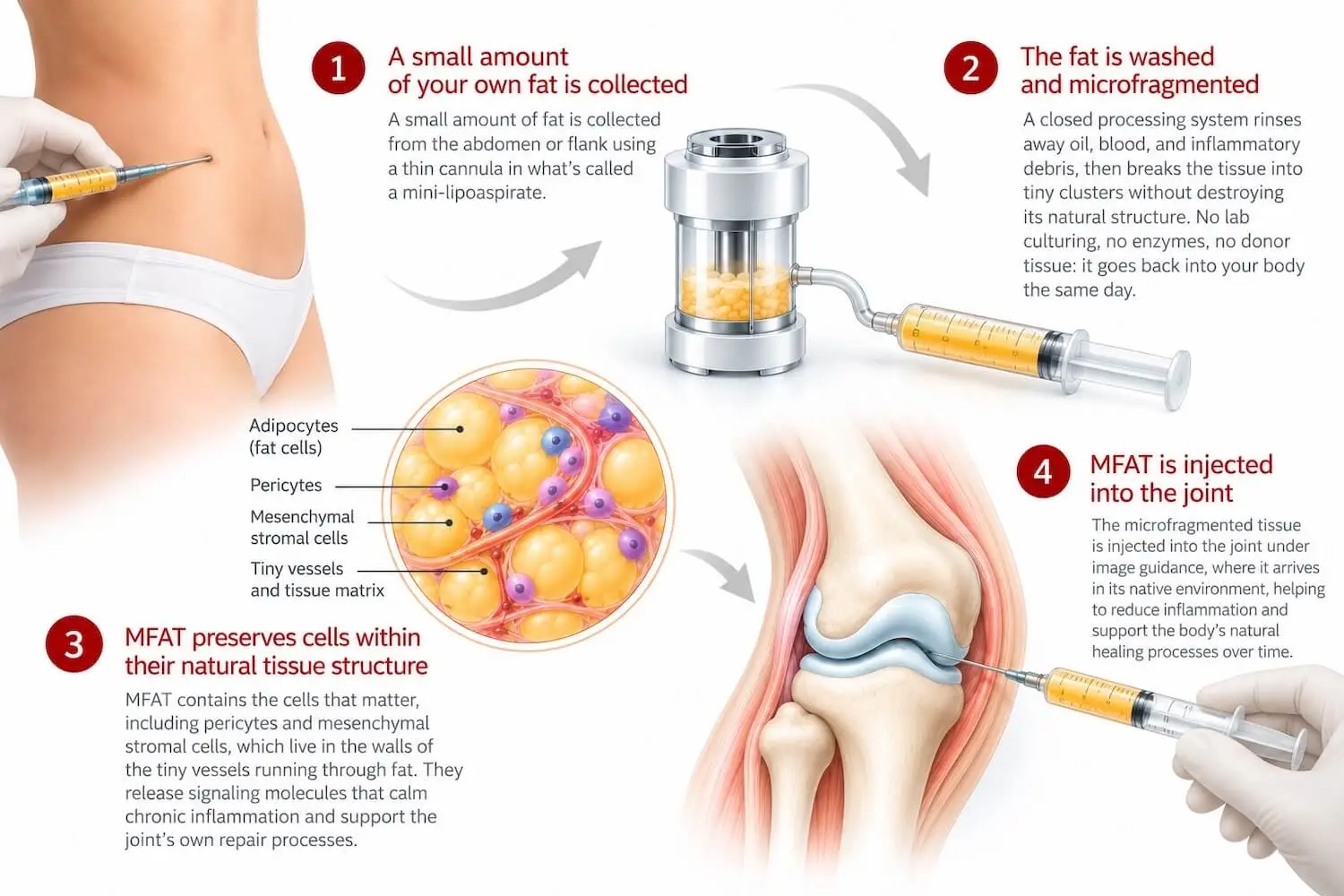
MFAT starts as a small amount of your own fat, collected through a thin cannula in what’s called a mini-lipoaspirate. A closed processing system rinses away oil, blood, and inflammatory debris, then breaks the tissue into tiny clusters without destroying its natural structure. No lab culturing, no enzymes, no donor tissue: it goes back into your body the same day.
The cells that matter, pericytes and mesenchymal stromal cells, live in the walls of the tiny vessels running through fat. Think of them less as building blocks and more as a pharmacy. They release signaling molecules that calm chronic inflammation and nudge the joint’s own repair processes into action. That’s the current thinking in the research: the benefit of fat-derived regenerative therapy comes mostly from this signaling, not from cells turning into new cartilage.
What sets MFAT apart is what it leaves alone. Other cell-based treatments reduce tissue to a liquid; microfragmentation doesn’t. It keeps the cells inside small pieces of their original scaffold, so they arrive in the joint still in the neighborhood they came from. That matters, because cells that stay in their native environment are better positioned to survive and keep signaling over time. Early research supports that rationale, and it’s why we treat MFAT as a distinct tool with its own place alongside BMC.
PRP concentrates growth factors from your blood. BMC concentrates cells from your bone marrow into a liquid. MFAT delivers small fragments of the fat tissue itself. Different source, different biology, different strengths. That’s why the choice between them belongs to your diagnosis.
| Factor | PRP | BMC | MFAT |
| Source | Blood drawn from your arm | Marrow drawn from the back of your pelvis | Fat drawn from the abdomen or flank |
| What’s delivered | Concentrated platelets and growth factors | Concentrated marrow cells and signaling proteins, in liquid form | Microfragments of fat tissue, cells still in their native structure |
| Harvest | Routine blood draw | Marrow draw under local anesthetic | Mini-lipoaspirate under local anesthetic |
| Typical treatments | 1 to 3 | Usually one | Usually one |
| Evidence base | Most established of the three | Strongest for knee and hip arthritis | Newer and growing |
In the exam room, the deciding factors are how much damage is there, how inflamed the joint is, and which harvest site makes sense for your body. Sometimes that adds up to MFAT. Sometimes it’s BMC, PRP, or prolotherapy. Either way, you’ll hear the reasoning.
MFAT’s evidence base is younger than PRP’s or BMC’s. That’s worth knowing before anything else. The strongest recent signal comes from a 2025 randomized controlled trial in Arthroscopy. Patients treated with MFAT showed consistent, statistically significant improvement in pain scores through one year. In the corticosteroid group, the benefit had faded by month 12.
Why does that comparison matter? Because cortisone is the shot most of our patients have already had, and they know how it goes: real relief for a while, then the pain comes back right on schedule. In this trial, the steroid did exactly that. MFAT’s improvement was still there at one year.
The open question is long-term durability. Follow-up beyond a few years is limited, and studies vary in how they select patients and measure results. That’s exactly why we measure our own. We track MFAT outcomes in our practice through Databiologics, so every recommendation we make is grounded in our patients’ results as well as the published research. Bring your questions, and we’ll take you through the evidence in detail.
The procedure itself takes one visit: a small fat harvest, processing on-site, and an image-guided injection into the joint. Before it comes a physician evaluation. After it come a few days of soreness and a gradual build back to full activity over the following weeks.
First, your physician examines the joint, goes through your imaging, and works out which of our four regenerative treatments fits it. MFAT only comes up if that evaluation supports it. If it does, you’ll talk through where the fat will come from, chosen around your body and your comfort. And if you leave without clear answers about your options, our Leave You Better Promise returns the visit fee.
We numb the harvest site, usually the abdomen or flank, and draw a small amount of fat through an incision a few millimeters long. The tissue is washed and microfragmented in a closed system, right there in the procedure room. Then your physician injects it into the joint under image guidance. It’s a longer appointment than a typical joint injection, and our team will give you exact timing ahead of time.
For several days, expect tenderness and some bruising where the fat was taken, plus swelling in the treated joint. Most people are back to their normal routine within a few days and build back to full training over the next several weeks, on a progression designed for that joint. The joint itself improves gradually, over weeks to months.
We use MFAT for degenerative joint conditions: joints where cartilage and the surrounding tissue have worn down over time, and a low, steady inflammation keeps them aching. Knee osteoarthritis is its most studied use. Whether it fits your joint gets decided case by case, at your evaluation.
This is where MFAT has the most research behind it. It may suit a knee with degenerative wear and inflammation that won’t settle, the kind where swelling and stiffness keep coming back no matter how carefully you manage your training.
In the hip, we consider MFAT for osteoarthritis of the joint itself, particularly when it’s started to cap how far you can walk, run, or play.
The right MFAT candidate usually has three things: a degenerative joint problem confirmed on imaging, pain that conservative care no longer controls, and every intention of staying active for years to come. Your health history and harvest site matter too, and both get a careful look at your evaluation.
MFAT may fit you if:
MFAT is usually the wrong choice if:
If MFAT isn’t right for you, we’ll tell you why, and what we’d do instead.

Patients choose Ethos for MFAT because we have no reason to oversell it. We also offer PRP, prolotherapy, and BMC, so MFAT only gets recommended when your diagnosis favors it, and your physician performs the harvest and the image-guided injection personally, in one visit.
Harvesting fat cleanly and placing it precisely take practiced hands. Those two steps shape how the whole procedure goes, which is why they stay with your physician.
Ethos is private pay, so your evaluation isn’t bound by an insurance-driven time slot. Your physician takes the time to explain how MFAT works, why it fits your joint, and what to expect at every stage, so you go into the procedure knowing exactly why it’s the right recommendation.
Our MFAT patients come from North Scottsdale, Paradise Valley, Arcadia, and Fountain Hills. Most are still training, competing, or simply refusing to let a joint set the terms of their week.
Is MFAT a stem cell treatment?
It contains your own mesenchymal stromal cells and pericytes, which are often marketed as adipose stem cells. A more accurate name is a minimally processed fat graft: the cells stay inside small fragments of their own tissue, and nothing is cultured or added. That distinction is useful when you’re comparing it with what other clinics advertise.
Where is the fat taken from, and will it change how I look?
Usually the abdomen or flank. We take a small amount, far less than cosmetic liposuction would, so most patients see no change in shape. The incision is a few millimeters long and usually heals to a mark you’d have trouble finding.
Does the fat harvest hurt?
The area is numbed before anything starts. Most patients describe pressure and a pulling sensation during the harvest, then bruising and tenderness for several days. Ice and over-the-counter pain relief usually take care of it. Your physician will tell you which pain relievers to use and which to avoid around the procedure, since some can interfere.
How is MFAT different from BMC?
From your side of things, the biggest differences are where the tissue comes from and where you’ll feel it afterward: BMC is drawn from the back of the pelvis, MFAT from the abdomen or flank. Biologically, BMC is a concentrated liquid and MFAT is tissue. Which one is stronger depends on the joint and the type of damage, and that’s what your evaluation sorts out.
How long do MFAT results last?
The 2025 Arthroscopy trial followed patients for a year, and the improvement held the whole way. Beyond that, the field is still collecting data. We follow our own patients’ outcomes over time, so we can tell you what we’re seeing in practice alongside what’s been published.
How many MFAT treatments will I need?
Most patients have a single MFAT procedure. If the joint might benefit from more down the road, you and your physician will decide that together, based on how it’s responded.
Is MFAT covered by insurance?
Insurance plans generally don’t cover MFAT, and Ethos doesn’t bill insurance for any treatment. You’ll know the full cost before you commit to anything, and we only have that conversation once MFAT is confirmed as the right recommendation for you.
If you’ve been weighing PRP, BMC, or surgery and no one has brought up MFAT, it deserves a place in that conversation. Book a Discovery Call with our Scottsdale team, and we’ll tell you whether your joint is a candidate.
Ethos Integrative Medicine proudly serves individuals in Scottsdale, Phoenix, Glendale, Mesa, and beyond.