Is Ethos Better Than a TRT Clinic?
Sep 28, 2026

By Dr. Matthew Hernandez, NMD | Co-Founder, Ethos Integrative Medicine
Your lab report says your testosterone is within the normal range. Yet you still feel off. You’ve noticed that your recovery is slower than it used to be. Your focus and metabolism aren’t what they were three years ago. Both things are true at once, and figuring out why is where most testosterone conversations go sideways.
I get a version of this question almost every week from patients here in Scottsdale. A man tells me his labs came back fine, and then in the next breath describes feeling like he’s running at 70% of himself. He starts to question whether he’s crazy, or worse, that this is just part of getting old. The mismatch isn’t in his head, it’s in the tool being used to measure him. Reference ranges, free hormone levels, sleep, cortisol, thyroid function, all of it factors in, and none of it shows up as a red flag on a standard panel.
So let’s start with the range itself, because that’s usually where the story breaks down.

Here’s what most men don’t realize about the “normal” number printed at the bottom of their lab report: it’s a statistical boundary, not a health target. The Endocrine Society defines it as the 2.5th to 97.5th percentile of a sampled population. In plain terms, that means it’s built to describe what’s common. Not what’s healthy, and certainly not what’s optimal for a 45-year-old who trains four days a week and runs a company.
| Quick Answer: What Is a “Normal” Testosterone Range? A “normal” testosterone range is a statistical boundary, typically the 2.5th to 97.5th percentile of a sampled population, not a health or performance target. It’s built to catch severe deficiency, not to define what’s optimal for an individual man’s biology or goals. |
A widely cited harmonized study reported a range of 264 to 916 ng/dL in healthy young men. Stop and look at that spread for a second: a man at 300 and a man at 900 both get the exact same word stamped on their chart, normal. Those are two completely different hormonal environments, two different capacities for recovery, muscle retention, and drive, and the lab treats them identically.
It gets worse the older you get. Harvard Health has found that roughly three out of four older men remain inside the lab-normal range even while reporting textbook low-T symptoms: fatigue, dropped libido, shrinking muscle. If you want a number that actually means something, it’s not the one on the chart, it’s the number you were at when you felt sharp, strong, and recovered. That’s your real baseline, and no population-derived range can hand it to you. You find it by tracking your own data over time.
We established that 264 to 916 ng/dL is one of the “agreed upon” ranges for testosterone levels in men. That’s a huge net, wide enough to catch nearly every man walking through the door, which tells you it was designed to flag severe deficiency and nothing more subtle than that.
Clinicians working in performance medicine use a tighter window. For younger men, that’s closer to 600 to 900 ng/dL, sometimes higher, a range where data show measurably better cognitive and metabolic outcomes. For older men, it drops to roughly 600 to 800 ng/dL, where body composition and vitality hold up best. Then there’s the zone I see cause the most confusion: men sitting at 300 to 399 ng/dL, technically inside normal but also experiencing symptoms anyway. And here’s the number that puts the whole thing in perspective: the Endocrine Society’s own data puts the median testosterone in healthy, non-obese young men at around 500 to 530 ng/dL. Clinical low-T isn’t even diagnosed until a man drops under 300. That’s the gap where high-performing men lose years of output while being told there’s nothing wrong with them.
| Range Type | ng/dL |
|---|---|
| Standard “normal” range | 264–916 |
| Median, healthy young men | ~500–530 |
| Performance-medicine target (younger men) | 600–900 |
| Performance-medicine target (older men) | 600–800 |
| Clinical low-T diagnosis threshold | <300 |
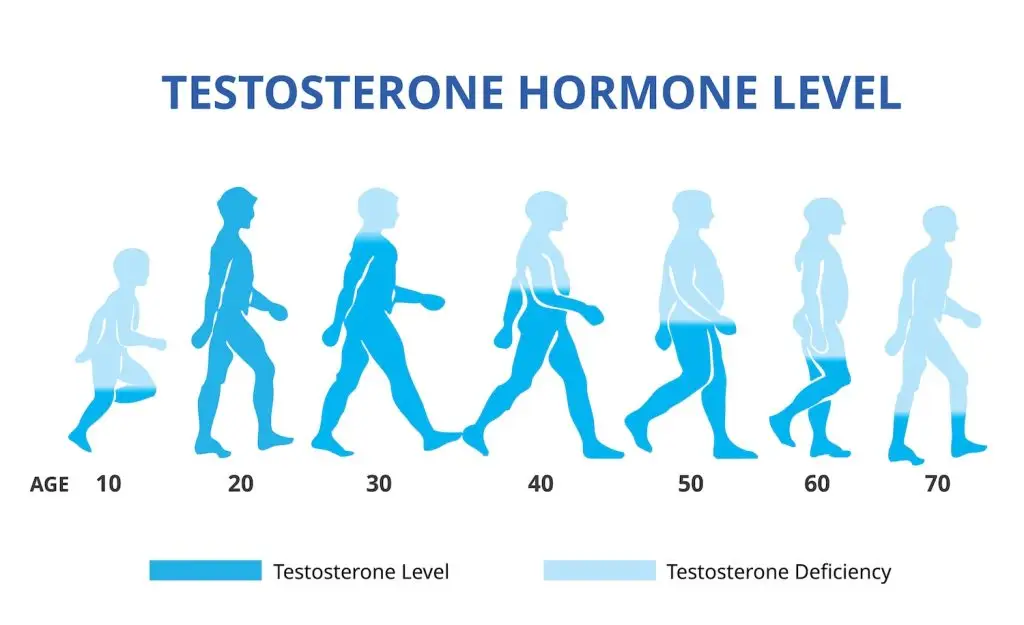
Testosterone isn’t a libido hormone with a few bonus effects. It regulates the systems that determine how you perform day to day.
Total testosterone is the total amount of testosterone in your blood, including the portion bound to proteins your cells can’t use. Free testosterone is the only fraction that can enter cells and activate androgen receptors. A 2025 systematic review found that in genuinely hypogonadal men, treatment produces real, measurable gains in sexual function, bone density, lean mass, and mood. While total testosterone is very useful to know, each of those benefits correlates with the amount of testosterone actually available to do its job.
This is where SHBG, sex hormone-binding globulin, quietly runs the show. It rises with age and binds up testosterone before your tissue ever gets to use it. Between 40 and 70, total testosterone drops about 0.4% a year. Free testosterone drops closer to 1.3% a year over that same stretch, because SHBG keeps climbing underneath it. Your total number can sit flat on paper for a decade while the hormone your body can actually access keeps sliding. That’s why it’s also important to measure free testosterone, albumin, and SHBG together.
Medications muddy the picture further. A 2021 clinical review named opioids, several antidepressants, and a handful of other common prescriptions as independent suppressors of testosterone function. They don’t always move the labs, but they do affect how well testosterone is used. If you’re on any of those medications, it’s worth factoring into your hormone picture.
Low testosterone rarely presents as a single obvious symptom. It chips away at several systems at once, which is exactly why men blame it on stress or age instead of getting it checked. Cleveland Clinic lists the physical picture plainly: reduced libido, fatigue, muscle loss, increased body fat, thinning bone density. Below about 430 ng/dL, men start reporting flat energy and slow recovery. In our experience, men who are more aware of their bodies may notice it at numbers above 430.
Regardless of where the threshold falls, this downward trend happens slowly over time, which is exactly why most men never connect the dots.
The mental toll is just as real, arguably more disruptive. A 2025 survey of men reporting low-T symptoms found 48% experienced low energy or fatigue, 47% had poor sleep, 34% reported reduced motivation, and 28% mentioned a low sex drive. Brain fog, trouble concentrating, and a shorter fuse show up just as often. A 2025 PMC review on testosterone decline in men confirmed that this kind of low-grade hormonal drag affects workplace output and quality of life even in men whose labs read completely clean.
A normal testosterone result doesn’t close the case. Several other factors suppress how your body actually uses testosterone without ever touching the total number on your panel.
SHBG is one culprit. The European Male Aging Study found that men with normal total testosterone but low free testosterone reported more symptoms of androgen deficiency than men with both markers in range, according to PMC data. Sleep is another, and the numbers here are hard to ignore. One week of five hours of sleep per night reduced daytime testosterone by 10 to 15% in healthy young men, roughly the hormonal equivalent of aging 10 to 15 years in seven nights.
One hormone often overlooked is cortisol. Chronic stress suppresses the pathway running from GnRH to LH to testicular production. That high-cortisol, low-testosterone combination is a big part of why recovery stalls and stubborn belly fat won’t budge. Metabolic health belongs in the same conversation. Obesity, insulin resistance, and thyroid dysfunction each independently drag down testosterone function.
It’s worth saying plainly: a lot of midlife symptoms have nothing to do with testosterone at all. Sleep apnea, depression, metabolic disease, and certain medications can all produce the same complaints. That’s exactly why a real workup looks at the whole system rather than chasing a single number.
| Three Reasons Your Testosterone Number Doesn’t Tell the Whole Story 1. Total testosterone doesn’t account for how much SHBG is binding it, so the number on your panel doesn’t reflect what your tissue can actually use. 2. Cortisol, sleep, and thyroid function all suppress how testosterone functions in your body, and none of them show up on a standard testosterone panel. 3. The reference range itself reflects population averages, not your personal baseline for feeling and performing your best. |
For men used to operating at a high level, the space between statistically average and actually optimized is where energy, focus, recovery, and resilience quietly leak out. Precision medicine holds itself to a different standard than a range built off population averages. Rather than confirming a patient’s labs are “normal,” our hormone optimization approach here in Scottsdale is built to confirm they’re optimal for that patient’s specific biology.

Wondering what your real baseline actually is? Our Health Intelligence Deep Dive measures free testosterone, SHBG, cortisol rhythm, and thyroid function together, not just the one number your last panel gave you. Book a Discovery Call to get started.
Are testosterone levels actually declining across generations?
Yes, and the data on this is not close. NHANES figures show young American men’s average testosterone fell from 605 ng/dL in 1999–2000 down to 451 ng/dL by 2015–2016, close to a 25% drop in sixteen years,. Today’s normal range is anchored to a lower starting point than the one your father’s generation was measured against. That alone makes optimization more relevant now, not less.
What if my symptoms match low testosterone but my doctor says my levels are fine?
This happens constantly. Mayo Clinic acknowledges directly that plenty of men with normal testosterone report the same symptoms as men who are clinically low, and that the link between the number and the symptom isn’t always clean. Ask for a full panel: free testosterone, SHBG, cortisol, thyroid markers (including Free T3, Free T4, and TSH), and IGF-1. A total testosterone number alone was never built to answer this question.
How does SHBG affect what my testosterone test actually measures?
SHBG binds testosterone in your blood, making it biologically inactive. An older man can show a normal total testosterone number while running low on the part that actually counts, bioavailable testosterone. That’s why free and bioavailable testosterone need to be measured alongside SHBG in any symptomatic man. Skip that step, and you miss the functional signal your tissue is actually working with.
When is testosterone replacement therapy the right call versus starting with lifestyle changes?
A 2023 JCEM clinical guideline says TRT is reasonable for men 50 and older with persistent hypogonadal symptoms, reproducibly low serum testosterone, and normal gonadotropins, but only after six to twelve months of lifestyle work first. TRT was never meant to be the first move on a borderline-normal lab. Sleep, resistance training, weight management, and stress reduction come first, not as an afterthought.
Can lifestyle changes actually improve how I feel even if my lab numbers don’t move?
Yes. Weight loss, resistance training, better sleep, and stress reduction can raise or stabilize testosterone and, just as important, can dramatically change how a man feels, even before the number on paper shifts. The Hypogonadism in Males study found that about 39% of men 45 and older meet lab criteria for low testosterone. Most are never properly evaluated, let alone given a structured lifestyle protocol, before someone reaches for a prescription pad.
What is the Health Intelligence Deep Dive, and what does it actually test for?
It’s Ethos’s initial evaluation, and it goes well beyond a standard hormone panel: free testosterone, SHBG, albumin, cortisol rhythm, a full thyroid panel, IGF-1, and a review of sleep, metabolic health, and medications, the same set of factors covered throughout this article. The goal is finding your actual physiological baseline, not just checking whether you land inside a population range.
How is this different from asking my primary care doctor for a full panel?
Most primary care visits are built around ruling out disease, not optimizing function, so a full panel request often gets narrowed down to total testosterone, if it’s ordered at all. A Health Intelligence Deep Dive is designed from the start to look at the free-versus-bound hormone distinction, cortisol rhythm, and metabolic markers together, and to interpret them against a performance standard rather than a disease-screening one.
If my testosterone is borderline, do I need TRT or can lifestyle changes help first?
Borderline usually means one of two things: an actual mild deficiency, or a normal total number masking a free-testosterone or SHBG problem, and those call for different next steps. Rather than guessing, a full workup identifies which one you’re dealing with before deciding whether lifestyle changes, a targeted intervention, or TRT itself is the right starting point.
Dr. Matthew Hernandez, NMD is Co-Founder of Ethos Integrative Medicine in Scottsdale, AZ, specializing in hormone optimization and regenerative orthopedics for high-performing adults.
Sep 28, 2026

Sep 12, 2025
Jul 25, 2025
Sep 28, 2026
Aug 28, 2026

Jul 30, 2026
Jul 15, 2026
Feb 17, 2026